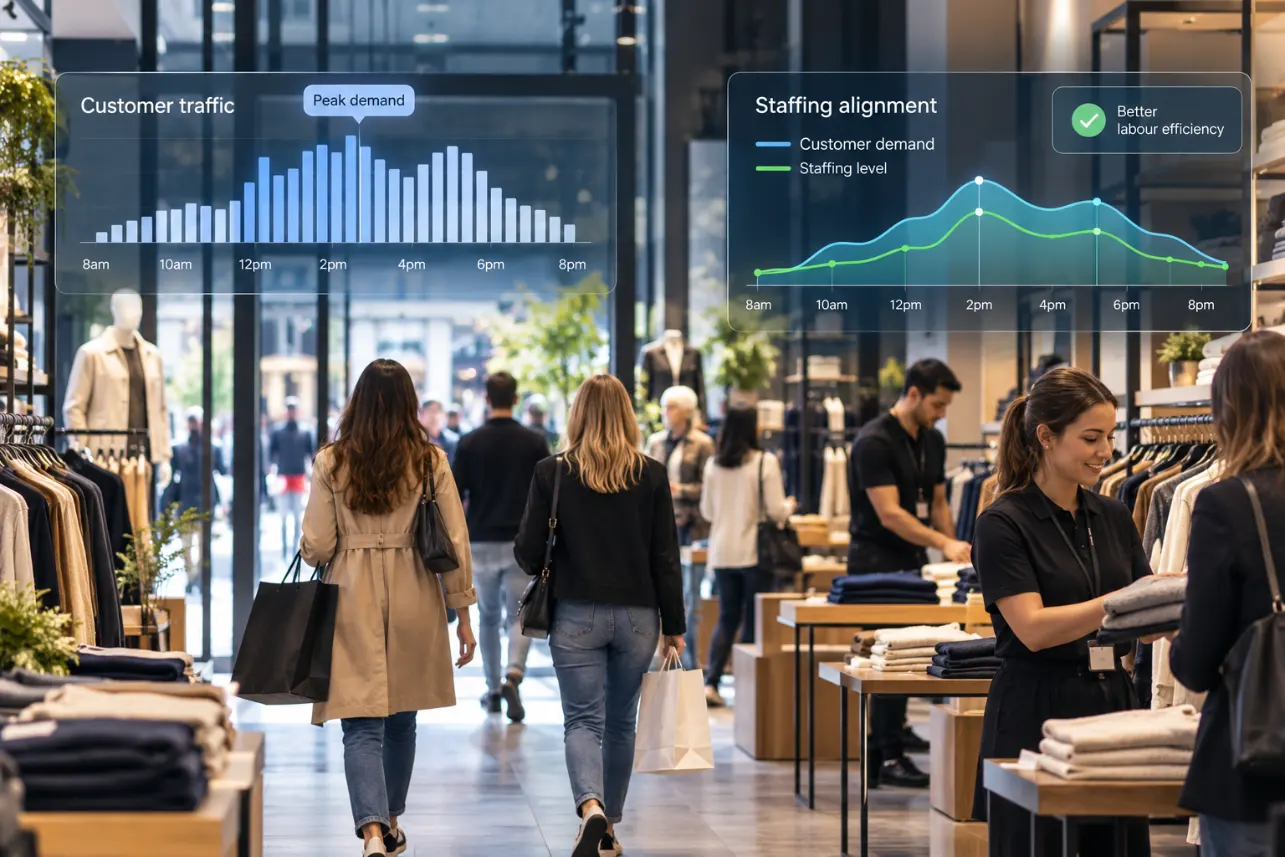
Why labour is the lever in retail cost management
Retail cost management is often discussed in terms of stock, suppliers, property and overheads. But for store operators, labour is one of the few major costs that can be adjusted week by week in response to changing customer demand.
The challenge is that labour cost management is not simply about reducing hours. Overstaffing during quiet periods creates unnecessary wage cost, while understaffing during busy periods can damage service, increase queues and reduce conversion. Both problems become much easier to see when labour hours are compared with actual store traffic.
That is why strategic cost management in retail should focus on where labour is used, not just how much is spent. The aim is to reduce labour costs where demand is low while protecting the hours that support customers when stores are busiest.
Key takeaway
Retail cost management is not about cutting labour evenly across every store or trading period. The aim is to align labour with customer demand, reduce wasted hours in quieter periods, and protect service and conversion when stores are busiest.
How to optimise staffing in retail with footfall data
Sales data can help retailers understand when transactions happen, and StoreTech can use sales data, footfall data or a blend of both to support staff scheduling. In practice, most customers use footfall as the primary alignment measure because it reflects the full customer opportunity entering the store, not just the customers who went on to buy.
That distinction matters. If staffing is planned only around sales, it can miss periods where stores were busy but conversion was weak because customers could not get enough help, queues were too long, or service levels dropped. Footfall shows the demand that actually arrived, including the people who left without purchasing.
A useful way to compare staffing with demand is the shopper-to-staff ratio. Looking at visitor numbers against available staff by hour and day helps retailers see where labour is too high, too low, or broadly aligned with customer traffic.
The aim is not to build the rota from footfall alone. It is to use demand data as a stronger starting point for labour decisions, then apply the operational knowledge of the store team. For the step-by-step process of turning traffic patterns into schedules, see our guide to scheduling with foot traffic data.
Predictive scheduling: forecasting labour demand before the week starts
Predictive scheduling uses historical trading patterns to estimate how much labour a store is likely to need before the week begins. Instead of building rotas mainly from habit or last year’s schedule, retailers can use demand data to create a more informed starting point.
For StoreTech customers, footfall is typically the primary alignment dataset, although sales data or a blend of both can also be used. Historical traffic by hour, day-of-week patterns and seasonality help show when customer demand is likely to rise or fall. Promotions, local events and weather can also affect demand, but these are additional planning considerations rather than live data feeds into the StoreTech scheduler today.
The process is straightforward in principle: forecast likely customer demand, apply an appropriate shopper-to-staff ratio, then use that to estimate the labour hours needed for each trading period. This is where predictive analytics in retail becomes practical. The value is not simply predicting what might happen, but giving store teams more time to plan the right level of resource.
Forecasts should also be reviewed against what actually happened. Comparing predicted demand with actual footfall each week helps retailers refine the assumptions behind their labour forecasting and improve scheduling accuracy over time.
For retailers that want to turn demand patterns into practical schedules, explore our retail workforce management software.
Using footfall data to plan store opening hours
Opening hours are another area where footfall data can support retail cost management. The first and last trading hours of the day can be expensive if customer demand is consistently low, particularly once wage costs, utilities and other operating costs are taken into account.
Rather than changing hours based on assumption, retailers can compare traffic, conversion and sales during the earliest and latest trading periods against the labour cost required to keep the store open. This helps identify whether those hours are commercially worthwhile or whether a different opening pattern should be tested.
Any change should be tested carefully. A useful approach is to trial revised opening hours in a small number of stores, then compare performance against similar locations that kept their existing hours. This helps separate the effect of the change from wider fluctuations in customer demand.
Retailers also need to account for practical constraints. Lease terms, shopping centre requirements, local trading agreements or brand commitments may limit how far opening hours can be changed, even where the data suggests an opportunity to reduce cost.
Running stores on live data
Forecasting helps retailers plan the week, but live data helps them respond to what is actually happening in the store. Customer demand does not always follow the forecast, and unexpected peaks or quiet periods can quickly make a planned rota less efficient.
Live footfall and performance data gives store teams the visibility to make better in-day decisions. If demand rises unexpectedly, breaks can be moved, colleagues can be redeployed from non-customer-facing tasks, and more resource can be focused on the shop floor. If trading is unusually quiet, teams can bring forward tasks or review whether labour can be reduced where contracts and operating policies allow.
This is where retail operational efficiency improves in practice. The value is not simply having a live dashboard, but using current demand data to adjust how labour and tasks are deployed throughout the trading day.
StoreTech supports this through live store dashboards and task management tools that help teams understand current performance and prioritise activity around customer demand.
| KPI | Formula | What it tells you |
|---|
| Sales per labour hour | Sales ÷ labour hours | How much revenue is generated for each labour hour worked. |
| Labour cost percentage | Labour cost ÷ sales × 100 | How much of sales revenue is being consumed by labour cost. |
| Shopper-to-staff ratio | Visitors ÷ available staff | Whether staffing levels are broadly aligned with customer demand. |
| Conversion by staffing level | Transactions ÷ visitors, compared by staffing level | Whether changes in staffing appear to affect how effectively stores convert customer opportunity into sales. |
No single KPI should be used on its own. A lower labour cost percentage may look positive, for example, but not if conversion and service levels are falling at the same time. The aim is to balance cost efficiency with the customer opportunity available in each store.
Comparisons should also be made like for like. Stores with different formats, trading hours or demand profiles may naturally operate at different levels, so the most useful benchmark is often against similar stores and the location’s own historical performance.
StoreTech business intelligence tools can help retailers compare labour KPIs across stores alongside footfall, conversion and sales performance.

Store performance is driven by three measurable levers: customer demand, conversion and transaction value. Understanding all three helps retailers make better operational decisions.
Proving the saving: a before-and-after method
Reducing labour hours is easy to measure. Proving that the change improved retail cost management without damaging performance is more important.
Start with a baseline period of around four to eight weeks before changing schedules. Record labour hours, wage cost, footfall, sales and conversion so you have a clear picture of both cost and customer demand before the change.
After the new staffing approach has been introduced, compare the same measures over a similar period. Where possible, compare the results against similar stores that kept their existing schedules. This gives a useful control and helps separate the effect of the labour change from wider trading conditions.
Footfall needs to be part of that comparison. If labour cost falls during a month when customer traffic also fell sharply, the saving may simply reflect lower demand. A stronger result is one where labour hours or wage cost improve relative to footfall while conversion and service performance are maintained or improved.
This before-and-after approach gives operations teams a clearer way to demonstrate the commercial effect of staffing changes, and gives finance teams the evidence they need to distinguish genuine efficiency improvements from simple cost cutting.
Key LearningMeasure efficiency against demand<
A lower wage bill is not automatically a better result. The stronger measure is whether labour cost improves relative to customer demand while conversion, sales and service remain protected.
Ready to See Where Labour Cost and Customer Demand Are Out of Sync?
Most retailers know what they spend on labour. The bigger question is whether those hours are being used when customers actually need them.
By combining footfall, conversion and staffing data, StoreTech helps retailers understand where labour is aligned with demand, where hours are being wasted, and where understaffing may be costing sales.
If you'd like to see how StoreTech can help you improve retail cost management without compromising service, we'd be delighted to arrange a personalised Retail Performance Review.
Book Your Retail Performance Review
David Kennett
Head of Technology & Operations, StoreTech
David has spent more than two decades helping retailers improve customer demand visibility, conversion and operational performance through data. His articles explore how people counting technology helps retailers understand customer demand and make better operational decisions.
Published 24 June 2026
Last updated 30 June 2026 | 12 min read